SynaCore AM-DT: Redefining Value Creation in Hydraulic Manifold Manufacturing
What Has Been Holding Back 3D Printing of Hydraulic Manifolds?
For decades, the production of these critical fluid control components has been constrained by subtractive manufacturing—machining solid metal blocks through drilling, milling, and cutting, with each pass generating waste and each design choice limited by tool accessibility. Even as additive manufacturing (AM) promised to break these constraints, the industry remained trapped in a cycle of fixed “recipes”—preset laser power, scanning speed, and other parameters that completely ignored the continuously evolving thermal history during the printing process.
The result? When engineers attempted to print complex hydraulic manifolds with intricate internal flow channels, thin walls, and overhanging structures, they encountered thermal stresses, unpredictable distortions, and microstructural inhomogeneity. Each failure demanded another round of costly trial-and-error, consuming time, material, and opportunity.
Advanced Mesher Technology: Silky Smooth Like Chocolate
The high precision and parallel computing of the SynaCore AM-DT digital twin set sail from Advanced Mesher technology, enabling high-fidelity, multiscale meshing of the most challenging hydraulic manifold features.
Hydraulic manifolds present a complex meshing challenge. Internal flow channels curve and branch with geometries optimized for fluid dynamics rather than manufacturability. Thin walls separate high-pressure zones. Overhanging structures defy conventional support strategies. Traditional meshing approaches either oversimplify these features—losing the very details that determine thermal and mechanical behavior—or demand computational resources that make layer-by-layer simulation impractical.
SynaCore AM-DT’s Advanced Mesher resolves this dilemma, generating meshes that capture complex flow channel geometries with curvature and branching; thin-wall structures with steep thermal gradients; overhanging regions prone to distortion and heat accumulation; and multiscale transitions between fine features and bulk sections.
Moreover, this meshing fidelity lays the foundation for subsequent precise multiphysics simulations and parallel computing. But Advanced Mesher is just the starting point. The true core capability lies in Multiscale Simulation—the SynaCore AM-DT digital twin seamlessly couples microscale material behavior with macroscale component response, enabling full-scale physical prediction from the powder melt pool to the complete built part.
Multiscale Thermo-Mechanical Simulation: The Symbiotic Evolution of Speed and Accuracy
Based on the high-fidelity meshes generated by Advanced Mesher, SynaCore AM-DT conducts layer-by-layer thermo-mechanical simulation, a key component of its multiscale simulation capabilities.
The simulation shown here demonstrates SynaCore AM-DT performing a layer-by-layer thermo-mechanical analysis of a hydraulic manifold connector. The calculation employs SynaCore AM-DT’s latest adaptive advanced meshing capabilities coupled with SynaCore AM-DT smooth-surface finite elements, revealing the layer-by-layer evolution of the temperature field during the printing process.
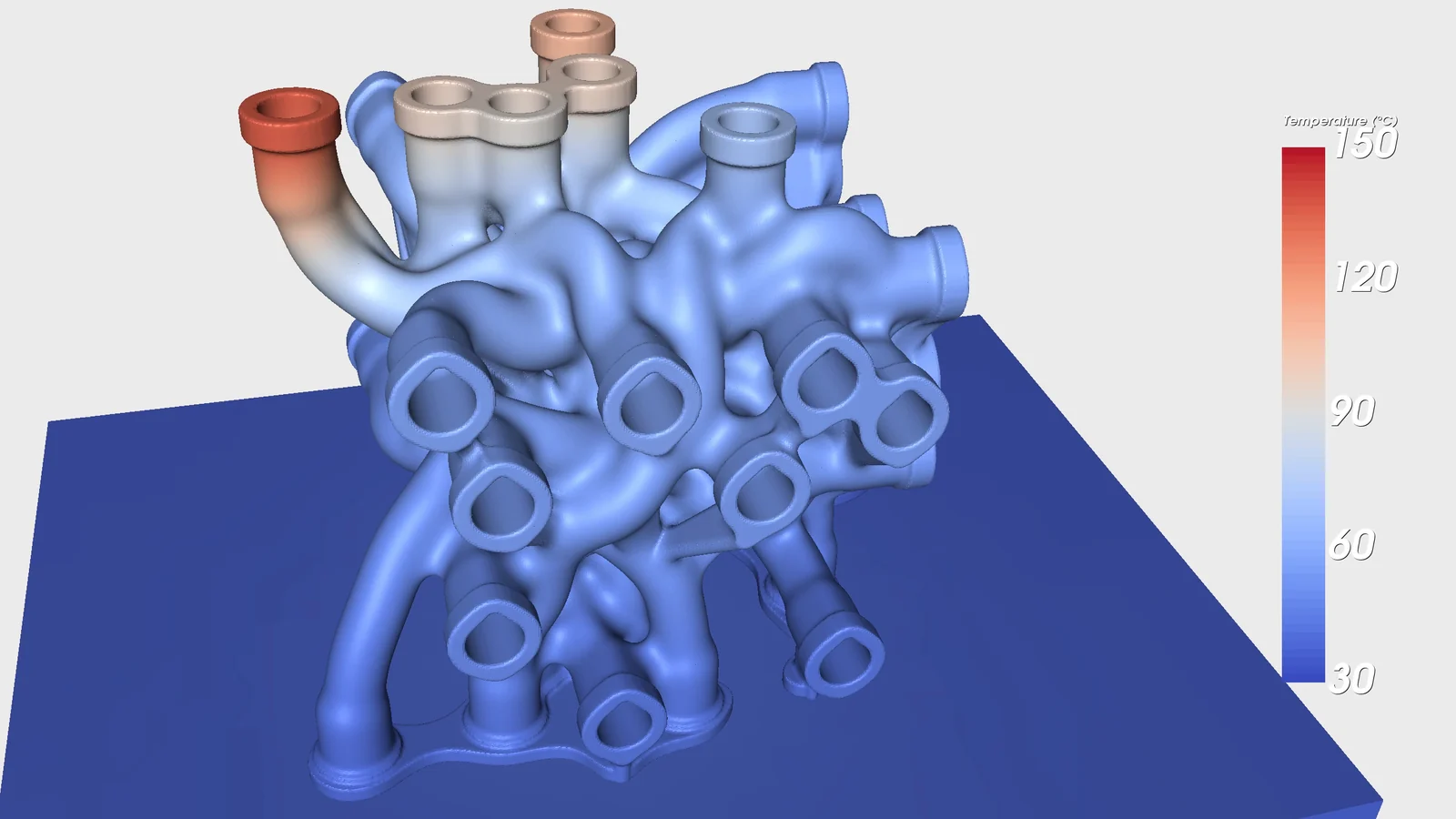
The color scale on the right tells the story with clarity: blue zones indicate lower temperatures; orange-red zones mark high-temperature regions. The simulation precisely captures the injection, conduction, and diffusion of heat during each layer’s deposition, as well as the cooling of completed layers. As the build height increases, the cumulative heat effect in complex geometric features becomes clearly observable—particularly the temperature gradient variations in thin-wall regions and overhanging structures. This precise prediction of transient thermal fields lays the physical foundation for understanding subsequent residual stress formation and mechanical distortion.
Multiscale Mechanical Displacement Simulation: Precise Layer-by-Layer Localization of Deformation Hotspots
Building upon the thermo-mechanical predictions, SynaCore AM-DT further conducts layer-by-layer mechanical displacement simulation, translating temperature field results into quantifiable deformation predictions and demonstrating the complete coupling capability of multiscale simulation from thermal to mechanical analysis.

This mechanical displacement calculation also relies on adaptive meshing and smooth-surface finite elements, achieving high-fidelity mechanical response analysis of complex flow channels, thin walls, and overhanging structures. The entire calculation completed in just two hours on 36 cores, including output and postprocessing for each layer, successfully uncovering important distortion locations in the lower region of the manifold connectors.
The color scale on the right displays displacement magnitude with unambiguous clarity: deep blue zones indicate minimal displacement, near zero; orange-red zones mark maximum displacement regions. As the printing process advances layer by layer, the simulation precisely reveals the concentration trend of deformation at the lower pipe-joint connections of the manifold connector—exactly the locations most prone to warping and thermal stress accumulation during additive manufacturing, where assembly failure often begins. By tracking displacement evolution layer by layer, engineers can intuitively identify high-risk deformation areas in digital space.
This is not post-build forensic analysis. This is predictive foresight—seeing failure and understanding distortion before the first layer of powder is ever melted.
Adaptive ToolPath: From Simulation Insight to Process Action
But prediction alone is not enough. The Adaptive ToolPath integrated within the SynaCore AM-DT digital twin software leverages the digital twin’s predictions of evolving thermal fields to enable adaptive laser scanning strategies throughout the build.
Adaptive ToolPath can reduce heat input in high-risk distortion zones identified by simulation, optimize scan direction to disperse residual stress rather than concentrate it, dynamically alter scanning paths in heat-accumulation areas to achieve uniform temperature fields, and compensate for interlayer heat buildup in tall thin-wall structures. This closed-loop intelligence represents SynaCore AM-DT’s treatment of each layer, each region, and each moment of the build as a unique thermo-mechanical event requiring its own optimized strategy.
The Flywheel: A Self-Evolving Intelligence Loop
Advanced Mesher, Multiscale Simulation, and Adaptive ToolPath—these software products do not exist in isolation. They constitute components of the SynaCore Fly Wheel, working together with other modules to create a self-evolving, continuously optimizing intelligent loop for its users.
The flywheel operates according to the following cycle:
1. Advanced Mesher → 2. Multiscale Simulation → 3. Adaptive Path → 4. AI Alloy → 5. Self-Evolution → 6. DT-Digital Passport → 7. Pre-Qualify → back to 1. Advanced Mesher, initiating the next round of optimization.

The SynaCore Fly Wheel creates compounding value over time for users of its AM-DT digital twin software. From advanced mesh generation, multiscale simulation, and adaptive path planning to AI alloy design, further closed-loop learning, digital passport, and pre-qualification—the entire chain is deeply coupled and continuously self-evolving, enabling its software users to build systemic advantages as a friend of time.
For manufacturers of high-value-added parts such as hydraulic manifolds, the implications are profound. The ability to predict and prevent distortion before printing means faster time-to-market for new designs. Reduced trial-and-error iteration means lower development costs and less material waste. Closed-loop learning capability means transforming the promise of design freedom into the reality of qualified production.
Let manufacturing evolve itself! SynaCore is defining a new paradigm of manufacturing!
Explore SynaCore software: AM-DT · Advanced Mesher · Adaptive ToolPath