The dual engine of "physics-driven + AI evolution" rewrites the development rules for metal alloys
The experience-based development of nickel-based superalloys, iron-based alloys, titanium alloys, and aluminum alloys remains mired in the quagmire of "empirical alchemy": lengthy R&D cycles requiring tedious trial-and-error through composition design, manufacturing, heat treatment, testing, and iteration; prohibitive costs under severe data scarcity, especially for mechanical property data under additive manufacturing conditions; and nearly infinite compositional spaces that make it impossible for traditional methods to resolve phase stability, solidification cracking sensitivity, and high-temperature performance degradation mechanisms under multi-principal element coupling.
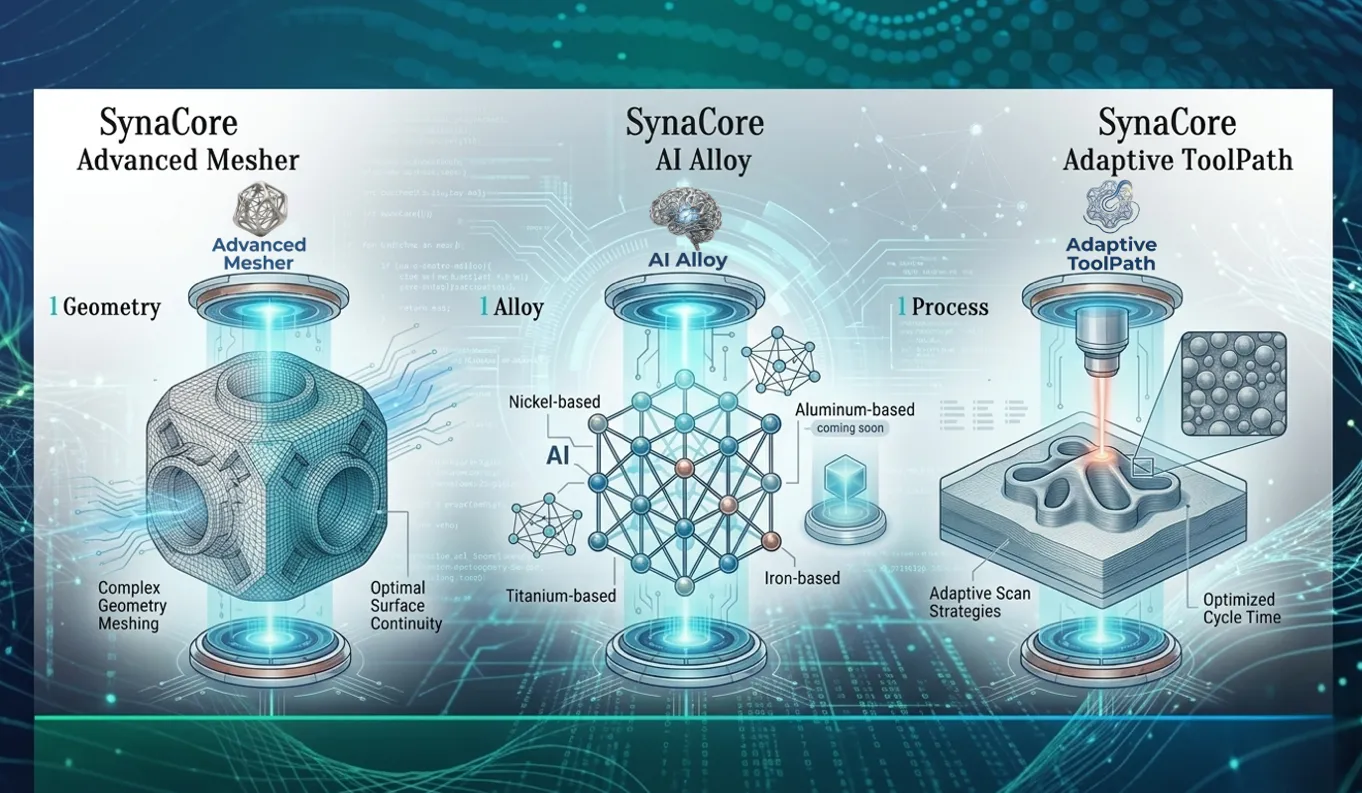
The AI Alloy module, developed by the Institute of High Performance Computing (A*STAR IHPC) and integrated within the SynaCore AM-DT Additive Manufacturing Digital Twin platform, is rewriting the development rules for alloys, including nickel-based superalloys, iron-based alloys, titanium alloys, aluminum alloys, and eventually high-entropy alloys, with its dual engine of "physics-driven + AI evolution."
AI Alloy does not merely accelerate experiments; it reconstructs the knowledge foundation of alloy design through "physics-embedded neural networks + first-principles parameters." It precisely locates the "golden formula" that balances manufacturability and high performance from infinite compositional combinations, establishes a self-evolving closed loop of design, simulation, validation, and data feedback, and transforms alloy development from slow, data-scarce trial-and-error into high-fidelity, digital twin-driven high-throughput innovation.
Tracing Back to 2021: The Genesis of AI Alloy Inspiration
SynaCore AM-DT's core capabilities did not emerge from nowhere; their technical inspiration can be traced back to 2021. Under the strategic sponsorship of Honeywell, A*STAR IHPC and A*STAR IMRE jointly launched the cutting-edge project on additive manufacturing of lightweight alloys via machine learning.
This project had clear industrial-grade objectives: to develop a novel aluminum-based high-entropy alloy that combines high strength with low weight, excellent additive manufacturing adaptability, and fundamentally avoids over-aging issues during high-temperature service.
In advanced manufacturing, additive manufacturing of lightweight metallic alloys is emerging as a strategic technical pathway for legacy equipment maintenance and critical component replacement. High-Entropy Alloys stand out because, unlike traditional aluminum alloys that rely on precipitation strengthening and suffer over-aging challenges, HEAs achieve strength enhancement through solid solution strengthening and fundamentally avoid mechanical performance degradation in high-temperature environments.
Lightweight High-Entropy Alloys are therefore regarded as strategic candidates for breaking through the performance ceiling of traditional aluminum alloys. These multi-principal-element alloys, with lightweight elements such as aluminum, titanium, and magnesium as their main constituents, must find a precise balance among density, strength, and additive manufacturing adaptability.
This project later became the inspiration for the SynaCore AI Alloy module:
- Using artificial intelligence to accelerate the complex material development process that traditionally takes years.
- Integrating IHPC's physical modeling, algorithms, and AI capabilities with IMRE's expertise in additive manufacturing modeling and experimental preparation to construct a machine learning-guided alloy design platform.
It is based on this attempt to combine physics-driven approaches with AI that AI Alloy within SynaCore AM-DT gradually matured, enabling the deep integration of A*STAR IHPC's computational advantages with A*STAR IMRE's experimental insights and extending its applicability to 3C precision manufacturing and other high-end equipment sectors.

The Dual Engine of Physics-Driven + AI Evolution
Unlike pure AI-driven material development, the core advantage of combining digital twin with AI lies in the physical rigor of its alloy design simulations. Surface tension and interfacial tension models derived from thermodynamic potential functions allow AI Alloy to reason within physically grounded boundaries rather than relying only on empirical pattern matching.
By integrating first-principles parameters such as thermodynamic phase diagrams, atomic size differences, electronegativity, melt viscosity, surface tension, and heat capacity with large experimental datasets, SynaCore AM-DT and the integrated AI Alloy together achieve high-precision, big-data-driven predictions that support:
- Density-performance Pareto frontier prediction to identify composition ranges that satisfy the dual objectives of high strength and low weight.
- Phase stability and over-aging immunity assessment, such as predicting single-phase solid solution formation after high-entropy alloying of lightweight elements.
- Additive manufacturability prediction, including hot-cracking sensitivity during LPBF caused by easily oxidized lightweight elements like aluminum and magnesium.
This "physics-embedded + AI-intelligent" hybrid architecture becomes the unique capability of SynaCore AM-DT's AI Alloy.
From Meeting Infinite Challenges to Creating Infinite Possibilities
The AI Alloy intelligent alloy development module integrated within the SynaCore AM-DT Digital Twin breaks the data-hungry bottleneck of traditional machine learning. Based on first-principles parameters such as thermodynamic phase diagrams, melt viscosity, surface tension, and heat capacity, AI Alloy combined with AM-DT can predict the phase stability and microstructural evolution patterns of different alloy compositional systems during additive manufacturing.
The integrated AI Alloy capability is currently applicable to the intelligent development of nickel-based superalloys, titanium alloys, and iron-based alloys. Intelligent development for aluminum alloys is planned for the second half of 2026, and applicability to high-entropy alloys is expected in the near future. Because HEAs are highly sensitive to minor compositional adjustments, the path toward intelligent high-entropy alloy development remains demanding even with the combination of digital twin and artificial intelligence.
Through LPBF additive manufacturing preparation, metallographic analysis, high-temperature mechanical testing, and CT non-destructive testing, real density, microstructure, and high-temperature performance data are obtained and fed back into the AI Alloy system integrated within SynaCore AM-DT. This model-data symbiosis mechanism enables the system's understanding of alloys to become increasingly accurate with use.
The AI Alloy integrated within SynaCore AM-DT constructs not merely a simulation tool, but a self-evolving innovation ecosystem for alloys. In this system, AI and physics-based simulation are deeply integrated, becoming a "virtual materials scientist" that understands the complex interplay between composition, process, and properties. When additive manufacturing meets metallic alloys, the impossible triangle of density, performance, and process is being dismantled by AI Alloy integrated within SynaCore AM-DT. This is not merely a technical upgrade, but a paradigm revolution from empirical alchemy to digital creation, enabling the next generation of lightweight, high-temperature stable, infinitely recyclable advanced metallic materials to first emerge in virtual space and then be precisely replicated in the physical world.
Explore SynaCore software: AM-DT · Advanced Mesher · Adaptive ToolPath · AI Alloy