How the Symbiosis of Digital Twin and AI Will Reshape Career Development and Enterprise Competitiveness
In the field of additive manufacturing, engineers have long faced a seemingly insurmountable dilemma: in Laser Powder Bed Fusion (LPBF) processes, high-fidelity simulations of melt pool fluid dynamics, while capable of capturing keyhole dynamics and microporosity formation mechanisms, demand hundreds of hours for a single full-scale computation. When process parameters require optimization, such temporal costs amount to nothing short of a disaster.
More despairingly, the curse of dimensionality strikes: as simulations scale from single-track scanning to multi-track, multi-layer scenarios, the computational complexity of traditional Finite Element Methods grows exponentially. Parametric design and process optimization become virtually impossible missions in engineering practice. Simulation engineers find themselves trapped in a catch-22 between accuracy and computational speed.
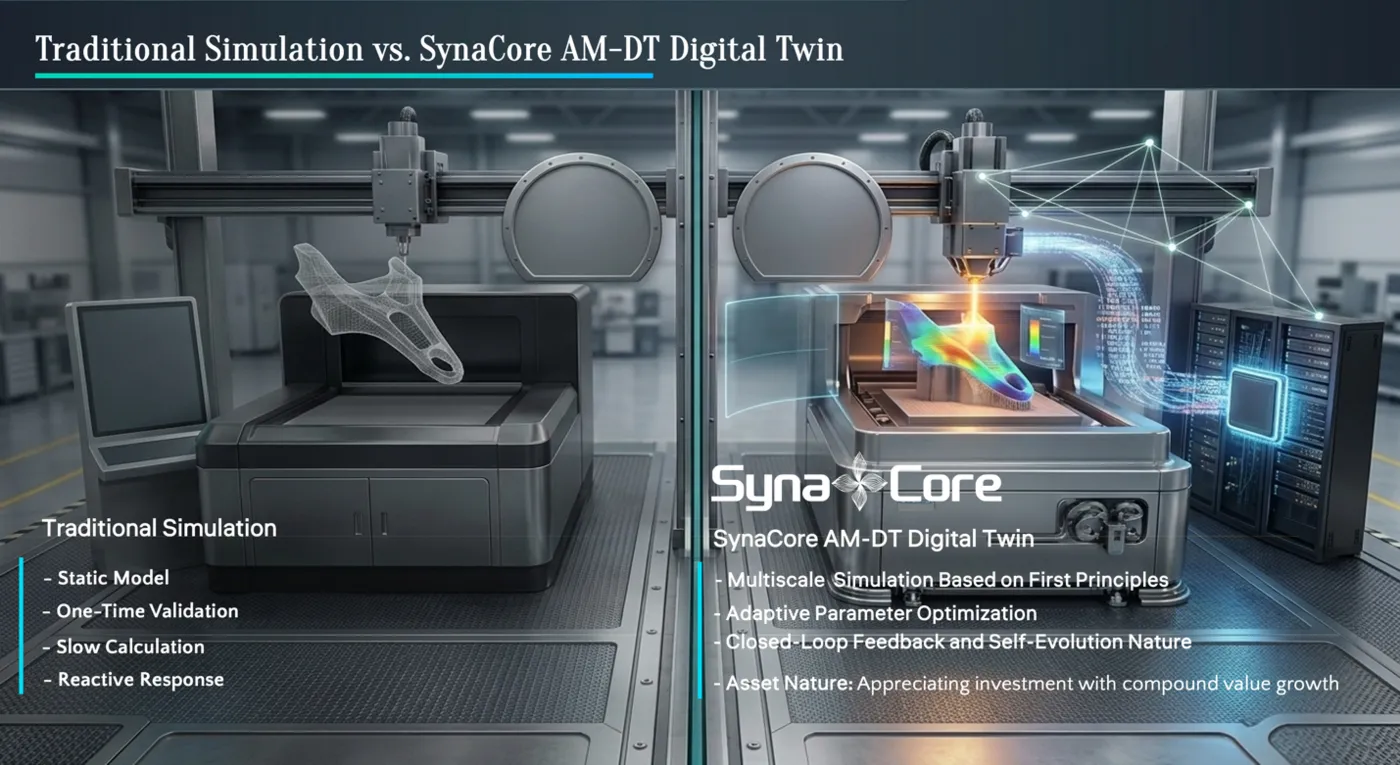
However, the symbiosis of Digital Twin and Artificial Intelligence is breaking this deadlock. This is not merely an iteration of tools, but a profound paradigm shift, one that will fundamentally alter the career trajectory of simulation engineers and reshape the core competitiveness of manufacturing enterprises.
From Solvers to Digital Twin: Paradigm Shift in Additive Manufacturing Simulation
Digital Twin is not a simple replacement for traditional simulation, but an architectural revolution. It constructs a multi-scale, multi-fidelity data-physics coupling system, tracking grain nucleation and growth at the microscale, resolving melt pool fluid dynamics at the mesoscale, and controlling thermo-mechanical coupling evolution at the macroscale, achieving full-chain integration of material-process-performance.
The core qualitative transformation of Digital Twin lies in the bidirectional closed-loop data exchange. Operating conditions from the physical entity feed back to the digital twin, while the digital twin's models simulate physical processes with progressively greater precision, forming a "perception-cognition-decision" adaptive loop. Taking SynaCore AM-DT Additive Manufacturing Digital Twin as an example, its thermal solver, grain growth model, solidification analysis module, and melt pool fluid dynamics solver operate in parallel.
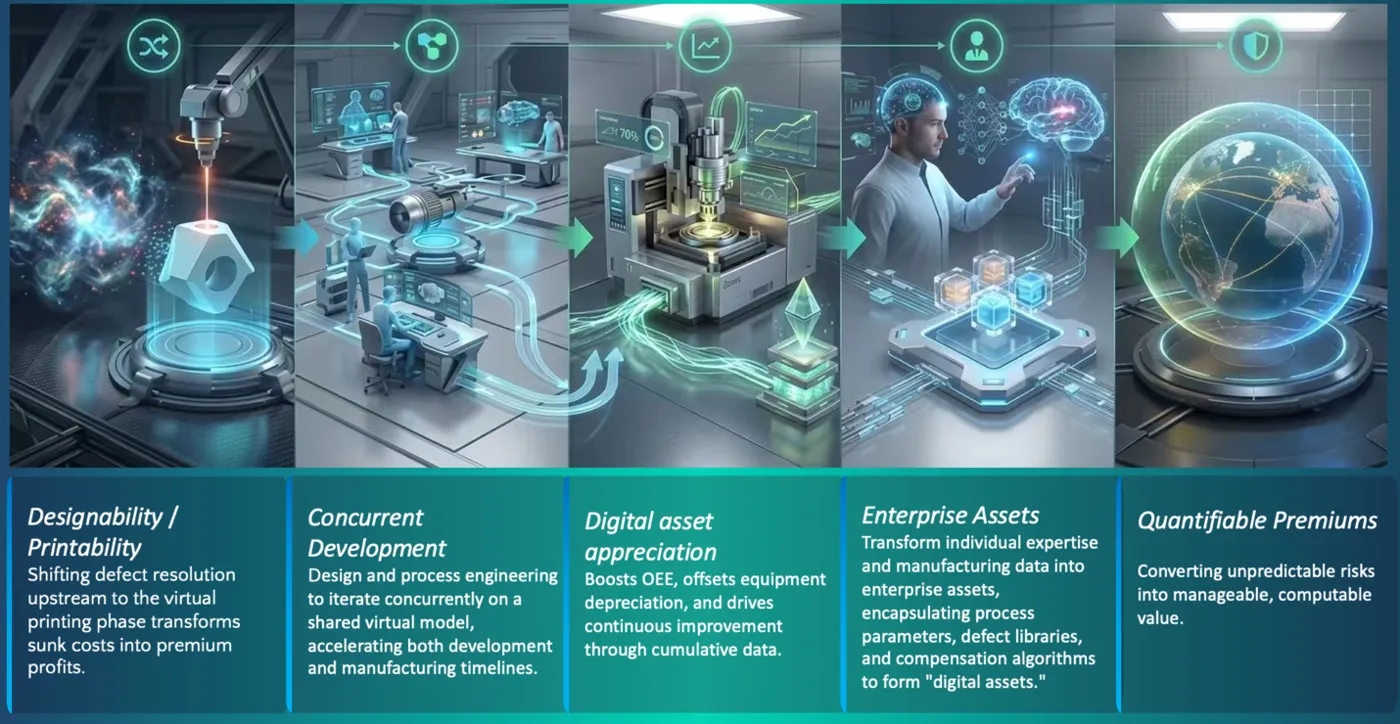
For manufacturers, this represents an opportunity to build a competitive moat. Far more than a technological upgrade, it constitutes a process of strategic asset accumulation. Every single print injects unique process fingerprints into the digital twin: phase transformation laws of specific alloys under particular thermal histories, influence patterns of complex path planning on residual stresses, and mapping relationships between environmental disturbances and defect evolution. These proprietary process knowledge precipitate into an inimitable data-intelligence barrier unique to each manufacturer.
The more extensively a manufacturer's digital twin is trained, the more irreplicable its process database becomes. As manufacturing batches accumulate, the predictive accuracy of the digital twin improves exponentially, and control over the process window grows increasingly precise, meaning that even if a manufacturer's competitors possess identical equipment, they cannot replicate equivalent levels of process stability and first-pass yield within a short timeframe. This becomes the most formidable competitive barrier, as well as an asset that appreciates with manufacturing volume for the manufacturer.
Career Reinvention for Simulation Engineers: From Operator to Architect
The impact of this paradigm shift on the career trajectories of simulation engineers runs far deeper than imagined.
Previously, a simulation engineer's core value resided in "which solver they could operate" and "how complex a mesh they could compute." Engineers who cling to traditional finite element methods and refuse to embrace data-driven paradigms face the risk of marginalization.
Future simulation engineers in additive manufacturing will evolve toward the digital twin domain, requiring the construction of "T-shaped capabilities." Vertical depth remains in physical modeling, including heat transfer, fluid dynamics, and solidification theory, while horizontal breadth extends to twin architectural thinking: understanding data flows and feedback loops between physical entities, sensor networks, and virtual models.
Along this career development path, Digital Twin-based Optimization Engineers will soon emerge, utilizing digital twins for process parameter adjustment and direct interaction with production lines. Digital Twin Operations Architects will also arise, managing the lifecycle of digital twins and addressing engineering challenges such as model drift and sensor calibration.
Career trajectories will shift from the traditional "siloed deep-well" model, spending an entire career mastering a single solver, to a "spiral ascent." Engineers will continuously switch perspectives between data analysis and production-line applications, with each transition bringing a higher cognitive dimension.
Reconstruction of Enterprise Competitiveness: From Simulation Capability to Twin Capability
For manufacturing enterprises, the symbiosis of digital twin and AI will reshape the fundamental dimensions of competition.
Traditional additive manufacturing R&D follows a "design-manufacture-test-correct" cycle, with each iteration taking weeks or even months. When digital twins are in place, enterprises can enter "virtual commissioning" mode, completing thousands of parameter scans through the twin body before physical manufacturing and directly outputting optimal process windows. R&D cycles compress from months to days.
More fundamentally, the self-evolutionary nature of digital twins makes "right-first-time" achievable. In metal additive manufacturing processes, sensors collect melt pool radiation signals. Through SynaCore's approach, the AM-DT digital twin predicts defect risks through constant learning and adjusts laser power, scanning speed, and other parameters through its integration with SynaCore AM-DT Digital Twin's Adaptive ToolPath. This means: every layer is being optimized. The significant reduction in scrap rates translates directly into cost advantages.
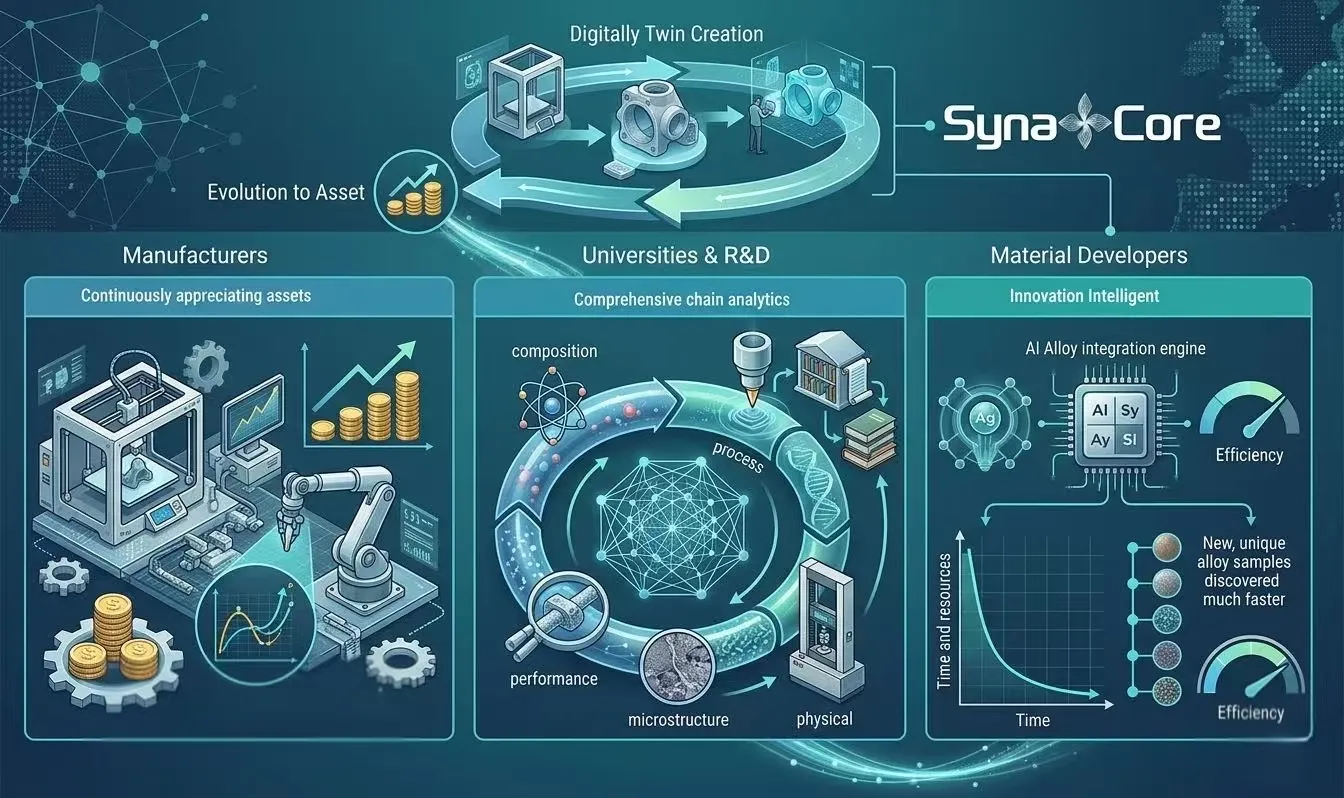
Based on digital twin software, manufacturers' value proposition will extend from "delivering parts" to "delivering process confidence." Their customers purchase not only physical components, but also the accompanying virtual twin and continuous optimization services. This "hardware + twin" composite value forms a new competitive barrier for manufacturing enterprises.
Dual Evolution: The Symbiotic Relationship Between Digital Twin and AI
Regarding technological development trajectory, Dual Evolution refers to the collaborative evolution process among the Digital Twin, its embedded AI, and external AI agents within the SynaCore AM-DT digital twin system. Under this paradigm, the Digital Twin constructs a virtual mirror of the physical 3D printing process, with SynaCore's thermal solvers, grain growth models, solidification analysis, and melt pool fluid dynamics solvers operating in parallel to provide high-fidelity training samples and virtual experimental fields for AI models. Meanwhile, AI continuously "feeds" the Digital Twin through deep learning of material behavior laws, prediction of defect evolution, and inverse optimization of process parameters, enhancing its predictive accuracy and computational speed.
The two form a closed loop: every print in the physical world enriches the knowledge graph of the digital world, while AI insights feed back to improve the precision of subsequent physical manufacturing. Through such bidirectional enhancement and spiral ascent, this ultimately drives additive manufacturing toward an adaptive, self-optimizing next-generation manufacturing paradigm, enabling users of digital twin software to establish a unique self-evolutionary competitive barrier.
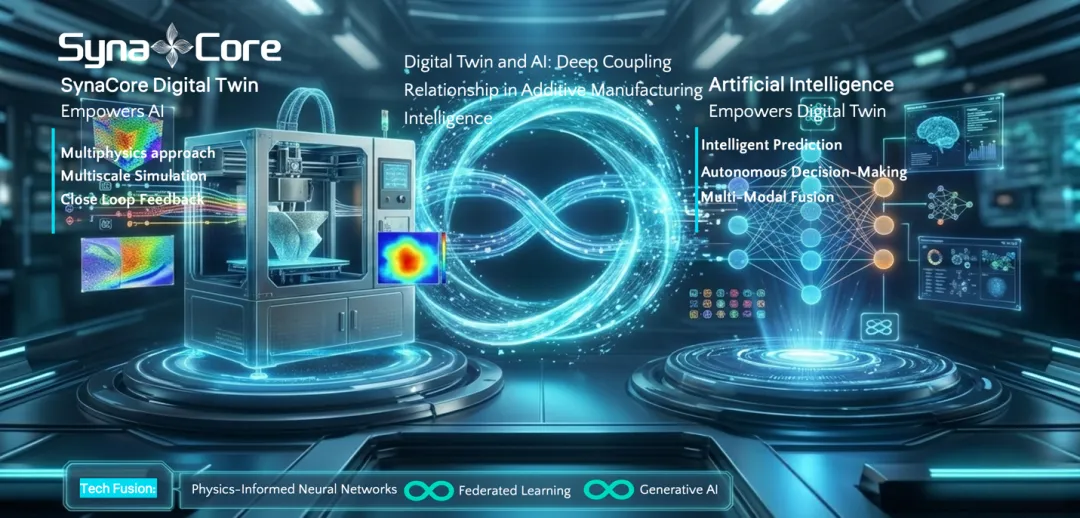
How Digital Twin and AI Reinforce Each Other
- Reduced-Order Modeling: By learning from SynaCore Digital Twin's high-fidelity simulation data, AI can construct surrogate models with extremely low computational costs, compressing calculations that originally required hundreds of hours down to seconds.
- Multi-Fidelity Fusion: Low-frequency low-fidelity simulations will collaborate with high-frequency high-fidelity simulations, with AI dynamically determining when to invoke which level of precision.
- Evolutionary Calibration: Sensor data, refined through AI calibration, feeds back into the Digital Twin, enabling the model to continuously approach the true state of the physical entity.
This deep coupling is further manifested in two directions:
- Physics-Driven AI: The Digital Twin, based on rigorous physical field equations such as heat transfer, fluid dynamics, and solidification theory, establishes physical boundaries for AI. This ensures that AI predictions consistently conform to the intrinsic laws of materials science, preventing absurd conclusions that pure data-driven approaches might produce.
- AI-Enhanced Physics: Machine learning algorithms make the Digital Twin more intelligent, enabling faster prediction of microstructural defects and even inverse optimization of designs.
In the future, the core asset of additive manufacturers will no longer be a process parameter sheet for a specific part, but rather a Digital Twin "brain" validated through millions of virtual experiments. These "brains" encapsulate an enterprise's most critical process knowledge and are difficult to acquire through reverse engineering, constituting a deeper moat than traditional patents.
Individuals and organizations that first complete this paradigm shift will occupy commanding heights that are difficult to surpass as additive manufacturing transitions from laboratory to production line.
Explore SynaCore software: AM-DT · Advanced Mesher · Adaptive ToolPath · AI Alloy