Toward Million-Unit 3D Printing of Smartphone Housings: DFM and Full-Chain Quality Verification Reconstruction Based on Digital Twins
"The consumer electronics industry is accelerating toward an evolution where high precision and mass scale go hand in hand. The million-unit mass production of titanium and aluminum alloy structural components marks the end of traditional trial-and-error additive manufacturing.
Today, the ultimate competitive barrier for high-end supply chains has shifted from pure 'manufacturing precision' to 'system-level validation capability': namely, how to demonstrate to top-tier 3C consumer electronic OEM brands that every unit—from a single part to million-unit batches—perfectly aligns with the complete quality certification closed loop from DQ (Design Qualification), IQ (Installation Qualification), OQ (Operational Qualification) to PQ (Performance Qualification).
The SynaCore AM-DT (Additive Manufacturing Digital Twin) software rises to meet this challenge, reconstructing physical boundaries through virtual mapping to serve as the core driving force for a new generation of manufacturing intelligence."

DQ (Design Qualification): Locking in "Fast-to-Right" Physical Design Through Virtual Mapping
Core Concerns of Leading 3C Brands:
In the consumer electronics race driven by extreme efficiency, how does one break the trade-off between "cutting-edge design" and "manufacturing feasibility (DFM)"? Under the relentless pressure to compress product time-to-market (TDM), any late-stage Engineering Change Notice (ECN) triggered by process limitations represents an unacceptable cost of trial-and-error. Taking the exceptionally high process thresholds of top-tier brands as an example, supply chains must fundamentally prove—before Design Lockdown—that the "material + process + equipment" technical pathway can deliver "99.98% mass-production repeatability." This demands the establishment of a panoramic Traceability System spanning from design inputs to verification testing, ensuring that every design feature decision is underpinned by solid, ground-level validation data.
The Validation Gap in Traditional Additive Manufacturing:
In conventional AM workflows, an insurmountable "silo wall" exists between R&D and manufacturing. Ultra-thin mid-frame designs or complex topology-optimized configurations produced by front-end teams often only reveal fatal defects—such as print failures or thermal-stress deformation—after entering physical prototyping (Proto/EVT phases), triggering cross-departmental Failure Analysis (FA) and rework cycles lasting weeks or even months.
SynaCore AM-DT's System-Level Reconstruction:
The SynaCore AM-DT Digital Twin platform is far from a simple replacement for traditional Finite Element Analysis (FEA). Instead, it constructs a multi-scale, multi-fidelity "data-physics" coupled system. At the microscopic level, SynaCore AM-DT tracks grain nucleation and growth and their impact on mechanical properties; drilling deeper into the mesoscopic dimension to resolve melt-pool fluid dynamics; and scaling upward to the macroscopic level to govern deformation and stress arising from thermal-structural coupling evolution. Through end-to-end data connectivity across "material-process-performance," SynaCore enables design teams to de-risk in virtual space, leveraging microscopic predictive power to elevate macroscopic yield.

In the past, to verify whether the overhang structure of a titanium alloy clasp would fail during printing, designers had to endure lengthy physical pilot runs. Today, with SynaCore AM-DT, Design for Manufacturability (DFM) analysis has crossed over into "physics-based computation." Leveraging cloud-based concurrent computing power, mesh calculations that once took months are compressed to mere days. Before any physical print begins, the SynaCore AM-DT digital twin completes parameter sweeps, outputting optimized process windows—and even Adaptive ToolPath parameters ready for direct printing—allowing design trade-offs and iterations to converge in the digital world.
The SynaCore AM-DT digital twin runs its grain growth model, solidification analysis module, and melt-pool fluid dynamics solver in parallel. This achieves true "more cores, more speed"—fundamentally distinct from the scaling bottleneck of "stacking cores without speed gains"—delivering value to users from the DQ phase onward and enabling rapid convergence of design iterations within the digital domain.
IQ (Installation Qualification): Breaking Hardware Barriers to Enable Global-Scale Exact Replication of Ultimate Capacity
Confronting the Ultimate Test of Globalized Supply Chains:
During the rapid expansion phase of consumer electronics, how can contract manufacturers rapidly replicate new production lines across global sites with zero quality deviation? The demand from top-tier brands is unequivocal: equipment installation is not merely about tightening screws, but about establishing a "trust baseline." Only by ensuring that equipment installation and calibration are fully digitally documented and locked can the risk of quality drift during subsequent mass production be cut off at the source.
Why is it difficult for traditional additive manufacturing equipment to achieve "exact replication"?
In the past, the industry attempted to achieve standardization by unifying equipment models and parameter sheets. Yet in reality, minute laser fluctuations or airflow variations between machines of the same model were sufficient to cause final part scrappage. This "process black box" phenomenon—where hardware parameters are identical but output results differ—severely hampered the pace of global capacity deployment.
Building the "Bidirectional Digital Closed Loop" and the "Digital Process Signature":
SynaCore AM-DT redefines equipment "cloning." Its digital twin no longer clones rigid parameters, but rather the "dynamic manufacturing capability" of the equipment itself. Next, as digital twin technology advances, the near future will see bidirectional intertwining of physical factories and digital space: deviations in real-machine operating conditions are captured and fed back to the twin, which then adaptively adjusts process strategies accordingly. Through an intelligent loop of "perception–cognition–decision," individual differences among physical machines are smoothed out.
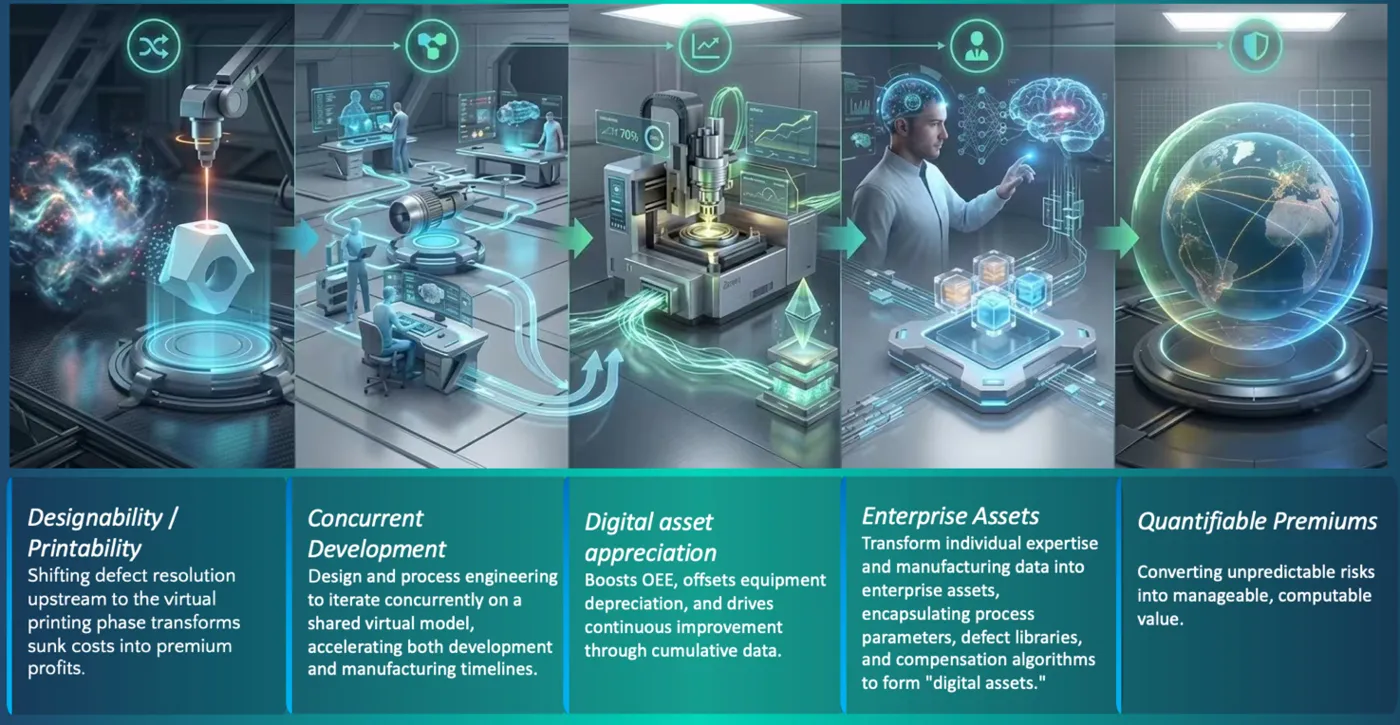
In the near future, accompanied by the continuous feedback of massive in-machine monitoring data, every physical print will carve out a unique "Digital Process Signature" for the enterprise within AM-DT. The phase transformation kinetics of specific alloys (such as Ti-6Al-4V) under complex thermal histories, and the nonlinear impact of high-energy beam path planning on macroscopic residual stress distribution—these deep process know-hows are fully extracted from individual engineers' personal experience and precipitated into a manufacturer-exclusive underlying data moat.
Furthermore, for additive manufacturing post-processing steps (such as heat treatment / HIP), SynaCore AM-DT digital twin also achieves full transparency. The platform pioneers a three-level cross-scale coupled engine of "macroscopic thermal field – mesoscopic elemental diffusion – microscopic microstructural phase transformation," converting the heat treatment "black box" that highly relies on empirical trial-and-error into computable microscopic crystal evolution pathways. As shown in the figure, for additively manufactured martensitic stainless steel, phase transformation differences at various temperatures can be pre-predicted in the software, thereby avoiding abnormally coarse grains and locking in the optimal strength-ductility matching window, providing a safety margin for heat treatment reliability.
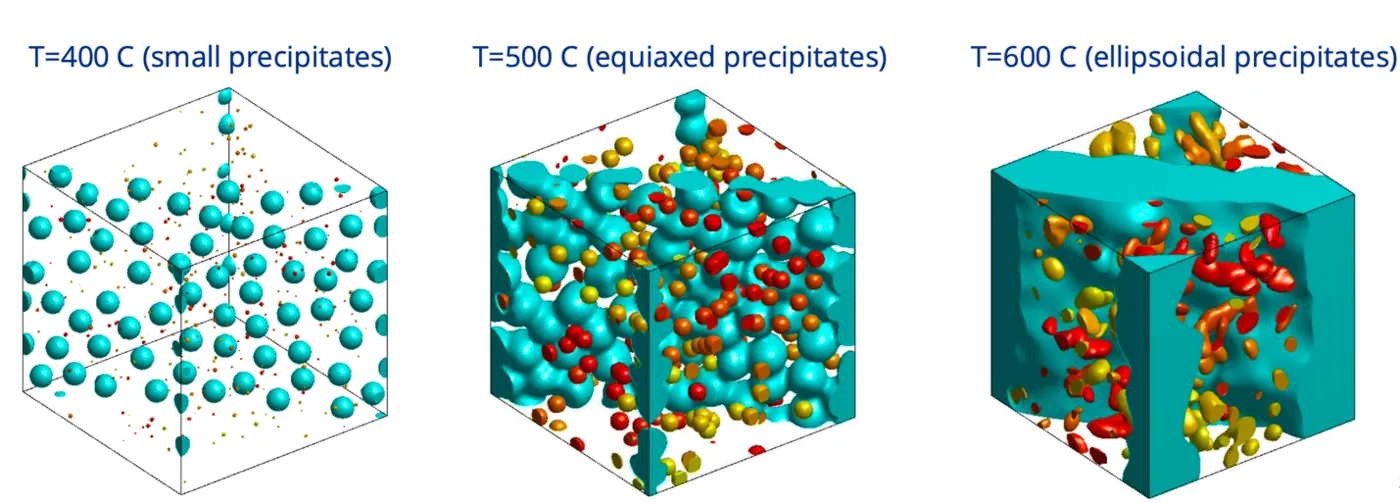
As shown in the figure, for additively manufactured martensitic stainless steel, differences in precipitate morphology, size, and distribution at various temperatures can be pre-predicted in the AM-DT digital twin software. In this case, this enables:
- Avoiding over-aging softening at 600°C
- Locking in the optimal zone of equiaxed particles near 500°C
- Providing a process safety margin for nanoscale strengthening via low-temperature aging at 400°C
This achieves full-process digital twin coverage for additive manufacturing, extending from "print prediction and optimization" to "heat treatment performance customization."
OQ (Operational Qualification): Crossing the Blind Spot of Static Parameters to Converge Mass-Production Uncertainty
Core Process Anxiety of 3C Supply Chains (CM/EMS):
On the eve of million-unit mass production (MP), how will microscopic perturbations in process parameters affect long-term yield? In the OQ phase, process teams must prove to customers that, within specified process tolerances, the production line can continuously output parts meeting Cpk (process capability index) standards. For titanium alloys and high-strength aluminum alloys heavily favored by consumer electronics, their forming process windows are extremely narrow. Traditional statistical process control (SPC) methods based on large-sample trial-and-error simply cannot exhaust the nonlinear process edge risks triggered by "complex thermal-mechanical coupling."
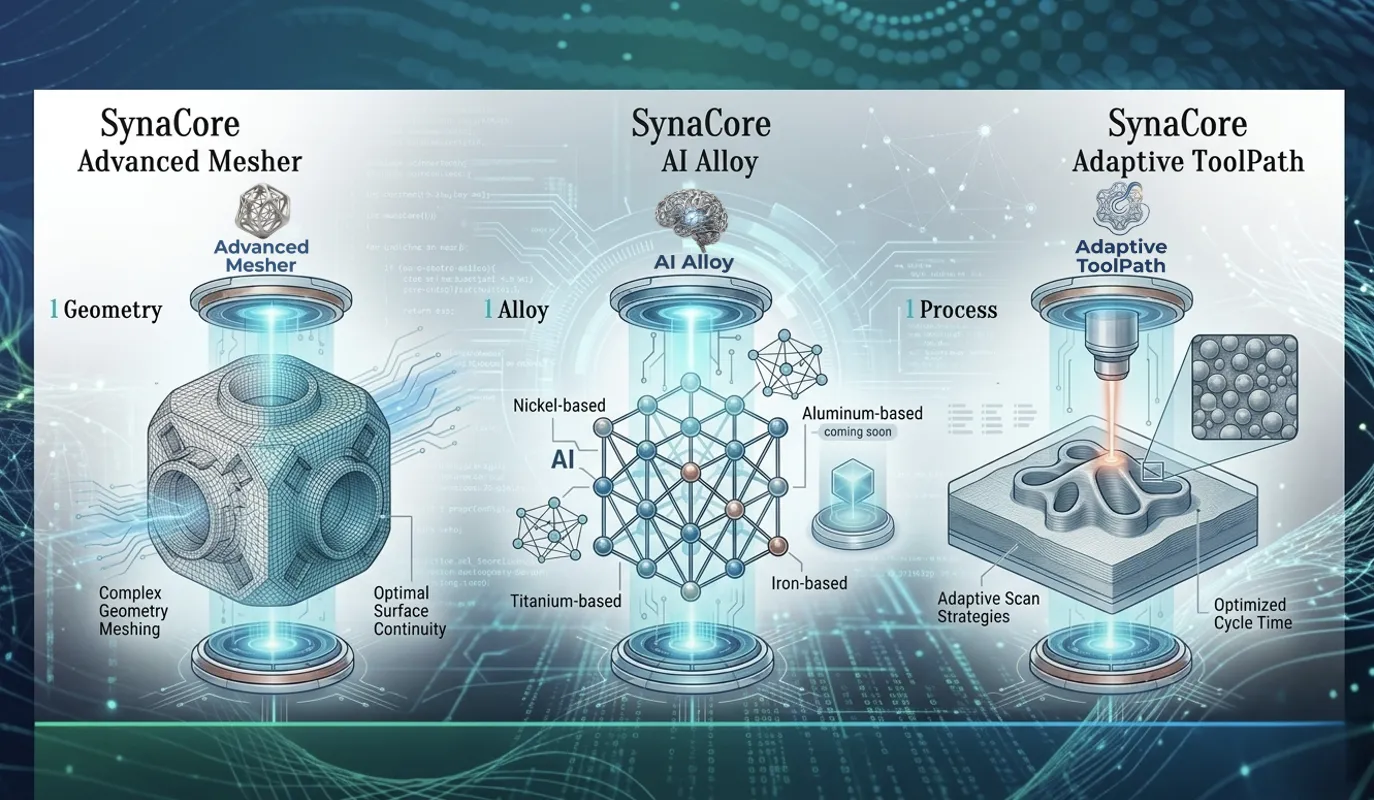
From Static Parameters to "Thermally Driven Adaptive Pathways":
Traditional LPBF (Laser Powder Bed Fusion) has long been trapped by "static recipes"—ignoring the dramatically evolving transient thermal field during printing, leading to local thermal runaway. SynaCore AM-DT breaks this constraint. Its Adaptive ToolPath Module, integrated within the digital twin, based on thermal finite element analysis, can panoramically predict the thermal response of parts before physical printing. The engine precisely captures and dynamically compensates for thermal anomalies across two dimensions: first, inter-layer heat accumulation (such as thermal annealing risks brought by tall, thin-walled parts); second, intra-layer transient thermal gradients. The system automatically generates scan vectors with optimal thermal characteristics accordingly, avoiding warping and collapse of complex structures such as overhangs, bridges, and thin supports. Furthermore, through precise prediction of overall deformation, AM-DT achieves seamless integration between 3D printing and CNC post-machining. By reserving adaptive deformation compensation margins, it ensures that dimensional Cpk remains stably high during million-unit mass production.
As process closed-loop feedback accumulates in a snowball effect, the SynaCore AM-DT digital twin system continuously absorbs real feedback from the manufacturing floor (such as deformation, lack-of-fusion pore distribution, etc.), converting it into data nutrients that nourish the evolution of the twin, enabling every subsequent print to achieve self-evolution by building upon prior experience.
PQ (Performance Qualification): Reshaping Destructive Sampling, Issuing the "Twin-Enhanced Digital Passport (DT-DPP)"
Core Reliability Anxiety of 3C Supply Chains:
Facing top-tier 3C brands, how can zero performance degradation across the full part lifecycle be ensured under extremely rigorous reliability tests (Rel Test, such as extreme drop testing, high-frequency bending fatigue)? Even more challenging, brand owners are mandating the construction of a "holographic traceability system" from powder material to finished product.
Reshaping Statistical Blind Spots and the Virtual-Physical Mutual Verification System:
Traditional PQ systems rely heavily on destructive physical analysis (DPA). The pain point of this verification mode based on statistical sampling (AQL) is that destroyed test samples can never represent the shipped entities, leaving a quality blind spot for uninspected products.
In the near future, SynaCore AM-DT will usher in a new paradigm of "Virtual Qualification." Before any physical part is printed, the digital twin will have already generated precise macroscopic mechanical property prediction reports based on locked process boundaries. It must be emphasized that this is not about eliminating physical testing, but rather constructing a cyber-physical mutual validation framework. Every physical part that successfully completes production will be anchored to a Digital Twin-enhanced Digital Product Passport (DT-DPP). Serving as an immutable "Digital Thread," this passport—combined with baseline data from physical sampling inspections—permanently archives the part's unique thermal process history and performance DNA, truly achieving an industrial leap from "accountability for batch-level probability" to "accountability for single-part certainty."
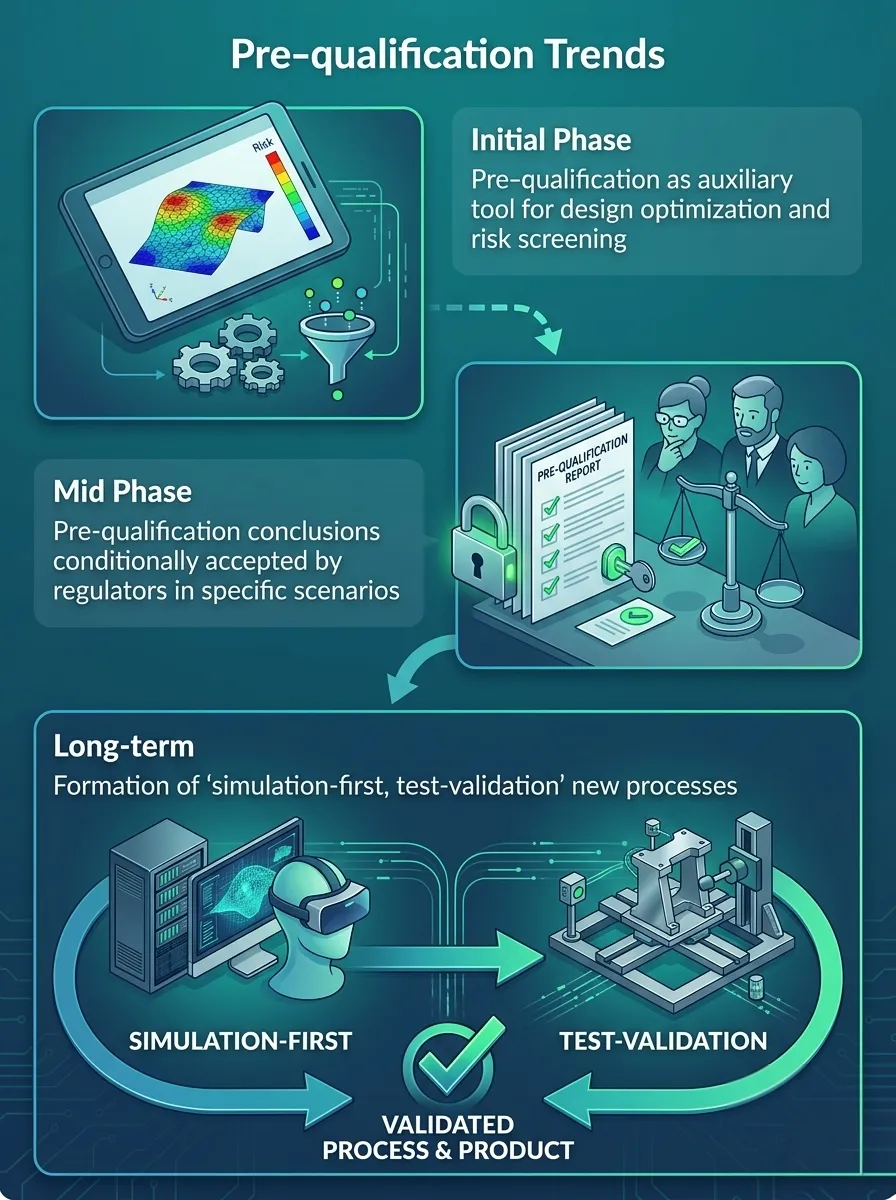
Creating Ultimate Customer Value: Driving the Convergence of Quality Certification with Pre-Certification
SynaCore AM-DT Digital Twin software, together with its built-in artificial intelligence capabilities, redefines the delivery standard for top-tier manufacturing. In the future, what brand owners receive will no longer be merely batches of cold, qualified hardware, but pre-certified ensembles bound to comprehensive, high-fidelity, and tamper-proof twin digital quality archives. The continuity of this Digital Thread will drastically streamline lengthy physical validation cycles and reshape the Cost of Quality structure.
More strategically, as leading brands accelerate their push for full-chain carbon neutrality, SynaCore AM-DT Digital Twin software provides the most penetrating foundational infrastructure. By precisely recording microscopic process energy consumption and material utilization rates, SynaCore AM-DT Digital Twin software further provides a digital base of the finest granularity and trustworthiness for rigorous ESG compliance audits, Scope 3 emissions accounting, and closed-loop material traceability—empowering manufacturers to secure a decisive advantage in the green supply chain competition of the future.
Explore SynaCore software: AM-DT · Advanced Mesher · Adaptive ToolPath · AI Alloy